Brazil could have 52,000 master’s and PhD students abroad; today there are 30,000

Updated: Jan 19

Despite its academic and professional potential, Brazil sends proportionally far fewer graduate students abroad than countries with a similar level of development, according to a study conducted by the Instituto Trajetórias in partnership with economist Pedro Nery.
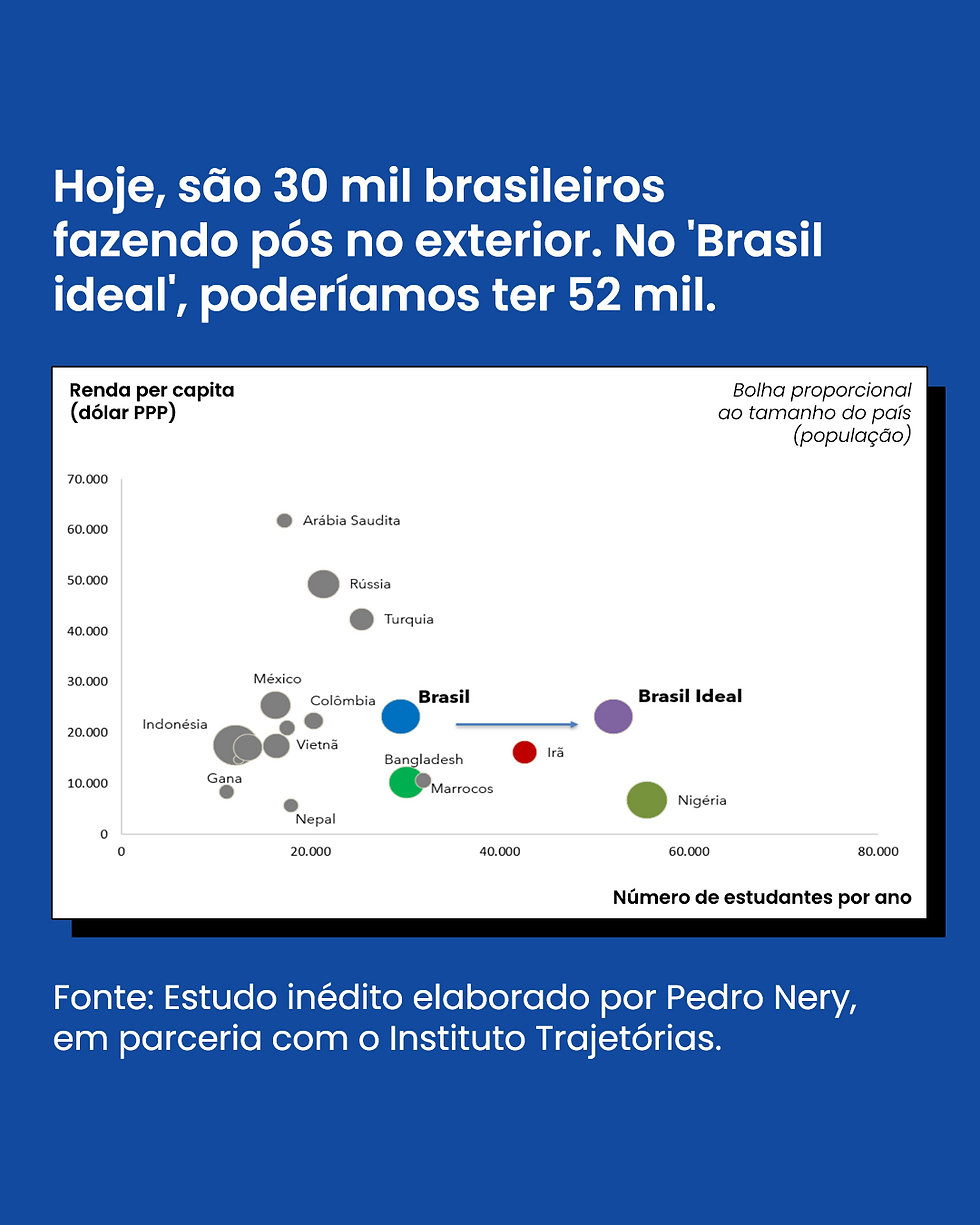
In 2022, Brazil had nearly 30,000 master’s and PhD students abroad. Compared with emerging countries, controlling for population and income, the country could have 52,000 talents enrolled in foreign universities.
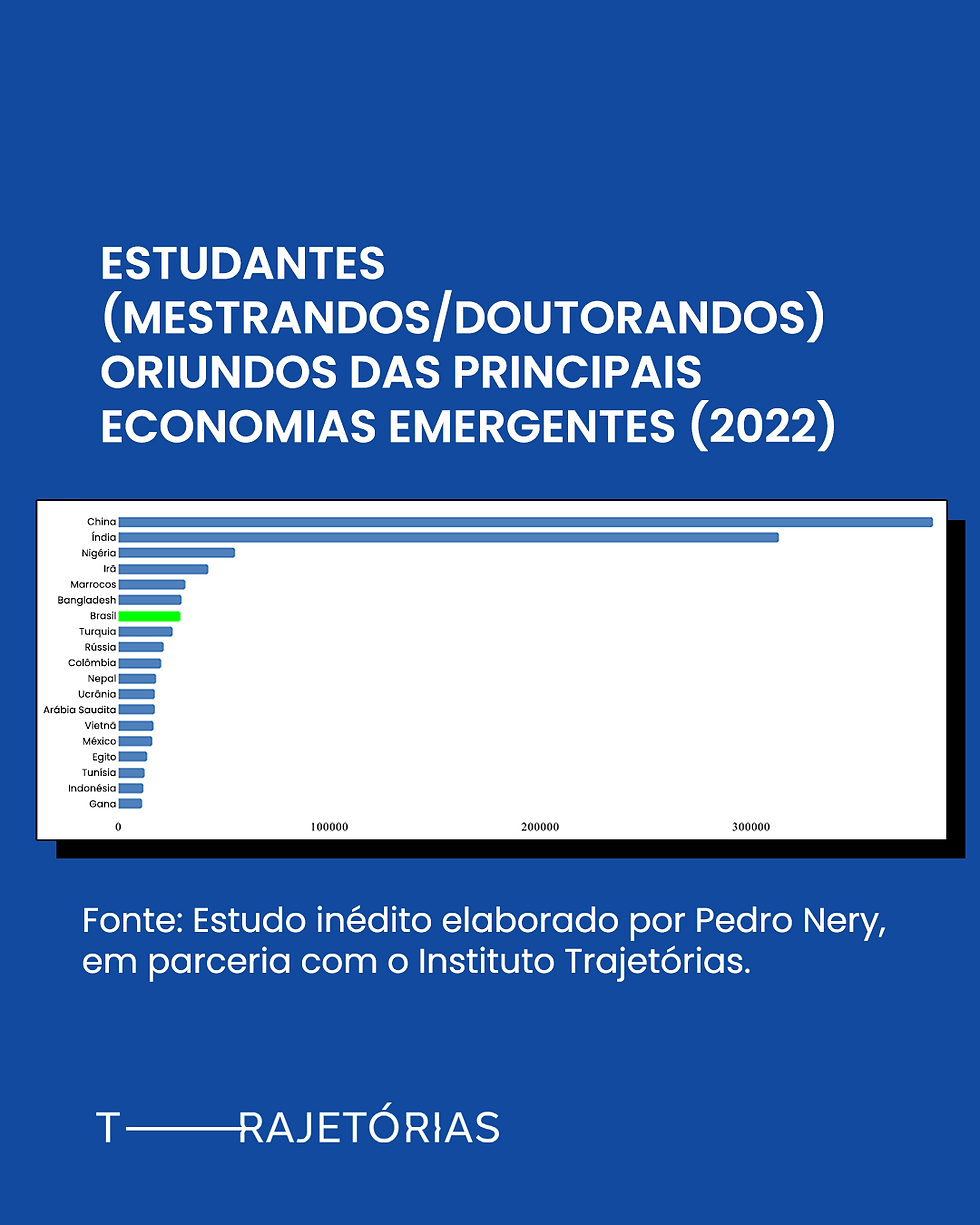
The Instituto Trajetórias study shows that graduate student mobility is concentrated in a few giants. In 2022, China and India alone accounted for two-thirds of master’s and doctoral students enrolled in the main destinations with the most internationally recognized universities (the United States, the European Union, the United Kingdom, Canada, Australia, and Japan). Each of the Asian countries had more than 300,000 students in these destinations. Next come Nigeria and Iran (both with more than 40,000 students).
Brazil, although leading Latin America, does not appear in the Top 5 of emerging countries—it ranks 7th.
“For a long time, we were stuck in a brain drain view—the flight or draining of brains from the country when qualified people go abroad. But now there is increasing talk about brain gain, that is, the advantages of this internationalization,” said Pedro Nery in a video published by Estadão, in which he cites the study conducted with Trajetórias as well as research published by the journal Science. “The main gain [of brain gain], of course, is when the student returns and brings back the knowledge acquired abroad. The literature also shows that people who go abroad end up inspiring others to do the same.”
“We also note that international mobility is not sought only by students from emerging countries, but also by those who already study in places with the best universities in global rankings,” says Leany Lemos, CEO of the Instituto Trajetórias.
According to the study, in 2022 Brazil had 900 master’s and PhD students in the United Kingdom—a number far lower than, for example, students from the United States (12,000), Germany (5,000), France (4,000), Canada (4,000), or Australia (1,000), even when controlling for the size of the university population.
The United States has one and a half times Brazil’s undergraduate student population. Maintaining the same proportion, Brazil “would have” 8,000 students in the United Kingdom.
In the United States—the country that receives the most international or foreign students in higher education, according to the OECD—there are far fewer Brazilians in master’s and PhD programs than students from countries such as China (six times more), or regional neighbors such as Colombia (four times more), as well as Mexico and Chile (twice as many). The figures come from Open Doors.
Get to know the Instituto Trajetórias
Instituto Trajetórias aims to change this scenario by working on several fronts: preparation, support to provide financial alternatives, and return.
In terms of preparation, there is Bússola Trajetórias, an open and free platform with tools that help candidates through checklists and support throughout the application process.
We also facilitate scholarships in partnership with states, municipalities, and Enap (the National School of Public Administration), part of the federal government. By the first week of January, the institute had secured partnerships for more than 540 scholarships over the next five years. In total, the amounts exceed R$85 million.
See the numbers:
Government of Rio Grande do Sul: 150 scholarships for the general public and 50 for civil servants
Government of Goiás: 75 scholarships for the general public and 75 for civil servants
City of Recife: will enable access for 43 civil servants
Enap: will enable access for 150 federal civil servants
We also negotiate discounts with universities and top-tier master’s programs—such as Yale, University College London (UCL), LSE, and Institut Polytechnique de Paris.
To learn more, visit our page with the agreements signed by the Instituto Trajetórias.


Comments